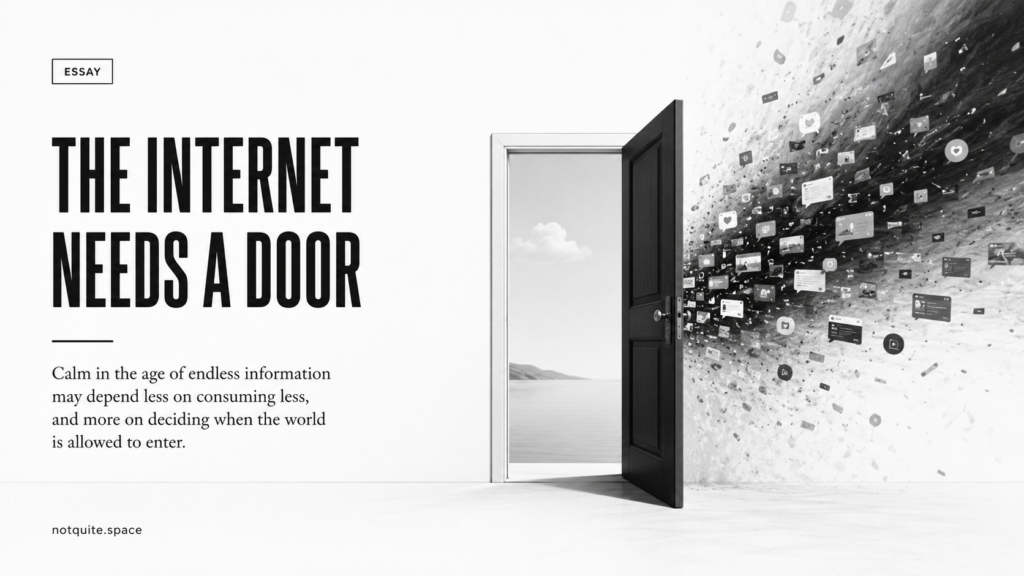
Calm in the age of endless information may depend less on consuming less, and more on deciding when the world is allowed to enter.
A library can contain ten million books without making you read a single sentence.
That is because a library has a door.
You enter it. You choose a shelf. You open a book. When you have had enough, you leave.
For most of human history, information had this kind of physical boundary. A newspaper arrived once in the morning. A letter had to be opened. The television lived in one room. Even the early Internet mostly waited inside a computer on a desk.
Then we put the Internet in our pockets.
Something subtle changed. Information stopped being a place we visited and became an atmosphere we lived inside.
The problem is often described as excessive screen time, information overload, social media addiction, or poor self-control. All of these can matter. But I think there is a deeper problem underneath them: we have lost the boundary between choosing to receive information and simply being available to receive it.
Our minds have become permanently permeable.
A message arrives while we are reading. A headline appears while we are eating. A video fills the thirty seconds while we wait for an elevator. We wake up and, before our own thoughts have fully formed, we can know what strangers are arguing about on the other side of the planet.
The Internet has no closing time.
So perhaps learning to be calm in the Internet age requires something more interesting than “using your phone less.”
We need to put the door back.
Calm is partly an architectural problem
We usually treat distraction as a contest of willpower.
The notification appears. You resist it. The phone is beside you. You refuse to touch it. The feed is one swipe away. You force yourself to keep working.
If you succeed, you call yourself disciplined.
If you fail, you blame yourself.
This is a strange way to design a life.
A 2015 experiment found that receiving a phone notification could significantly impair performance on an attention-demanding task even when participants did not touch the phone. The interruption had already happened. The sound or vibration was enough to pull part of the mind elsewhere. t distinction matters.
You do not have to open every door for someone knocking outside to disturb the room.
This is why I suspect that the most useful form of digital discipline happens before temptation appears. Instead of repeatedly asking ourselves to resist information, we can decide in advance which information is permitted to reach us, where it may reach us, and when.
That turns calm from a personality trait into a form of architecture.
A quiet mind needs gates.
The permission gate
Most smartphones are configured as if every application has the right to interrupt their owner.
It is worth reversing that assumption.
A phone call from someone important may deserve to reach you immediately. A security alert might. Perhaps a calendar reminder does.
Does a news app?
A shopping app?
A social network telling you that someone posted something?
Those things can still exist without possessing permission to summon you.
This difference separates push from pull.
When information is pulled, you decide when to approach it. When information is pushed, someone else decides when it enters your attention.
That makes notification settings more important than they look. They are not merely cosmetic preferences. They are access permissions to your consciousness.
And total silence is not necessarily the answer.
In a 2019 field experiment with 237 participants, researchers compared normal notifications with several alternative schedules. Delivering notifications in three predictable batches per day was associated with participants feeling more attentive, less stressed, and more in control of their phones. Interestingly, people who received no notifications at all experienced more anxiety and fear of missing out. useful lesson is more nuanced than “turn everything off.”
Human beings need communication.
What exhausts us may be the absence of rhythm.
The place gate
There is another distinction I find useful: some digital things are tools, while others are streams.
A calculator waits.
A map waits.
Your camera waits.
A banking app waits.
You open these tools because you already know what you want them to do.
A stream behaves differently. News feeds, short-form video, recommendation engines and social feeds continually manufacture the next thing to consume. They do not merely answer an intention. They provide new intentions.
Putting tools on a smartphone makes enormous sense.
Putting every stream humanity has created on the same object that sleeps beside us is a stranger decision.
One way to regain calm is therefore not to abandon technology, but to give different technologies different homes.
Messages may live on the phone. Long reading may happen on an e-reader. Social media may exist only on a computer. The computer may stay at a desk. The phone may charge somewhere other than beside the bed.
These sound like small logistical choices. Their importance is that they restore geography.
If checking a certain website requires sitting at a desk, then standing up and leaving the desk ends the experience. Physical space supplies the stopping rule that software often removes.
The Internet becomes a place again.
The time gate
Email offers a simple example of what happens when communication loses boundaries.
In a two-week experiment involving 124 adults, researchers asked participants during one week to limit email checking to three times a day, while during another week they could check as often as they liked. Participants reported lower daily stress during the limited-checking period. ice what was not required.
They did not quit email.
They did not declare communication unhealthy.
They gave it an appointment.
This principle can extend far beyond email.
There can be a time for reading the news rather than living inside the news. A time for answering messages rather than maintaining continuous partial readiness for them. A time for entertainment that is genuinely enjoyed, rather than entertainment leaking into every unclaimed minute.
The exact schedule matters less than the existence of a schedule.
Once something has a time, it no longer needs every time.
Do not measure only hours. Measure entrances.
Screen-time dashboards encourage us to think in quantities.
Three hours is bad. Ninety minutes is better. Forty-five minutes is even better.
Sometimes that is useful. But imagine two people who both use their phones for two hours per day.
One uses it in four deliberate thirty-minute periods.
The other looks at it for a minute or two from waking until sleeping, whenever a thought becomes difficult, a conversation pauses, work slows down, or boredom appears.
The arithmetic may be identical.
The experience of consciousness is not.
The second person’s day has hundreds of tiny entrances.
That may be a more useful thing to notice than total screen time: how often does the outside world get to begin a new thought inside your mind?
This also explains why replacing one compulsive app with another does not solve very much. The content changes; the pattern remains.
A calmer relationship with technology requires reducing unnecessary entrances.
Before opening a device, it can help to know the verb.
I am replying.
I am looking something up.
I am booking something.
I am reading this article.
A defined action contains its own ending. “Check my phone” does not.
Neither does “see what’s happening.”
The most dangerous digital activities may be those with no answer to the question: What would make me finished?
Leave some moments undefended
There is one boundary that may be harder to restore than all the others.
Boredom.
The smartphone has made it possible to prevent almost every empty moment from surviving.
Waiting for food. Sitting in a taxi. Walking from one building to another. Standing in line. Going to bed slightly before sleep arrives.
We can fill all of them.
And because we can, emptiness begins to feel like a malfunction.
But the mind may need periods in which nothing new arrives.
A meal is digested partly because we stop eating. Thought may work similarly. Experiences need somewhere to settle. Questions need time to remain unanswered. An idea sometimes needs to wander around before another idea replaces it.
There is a peculiar kind of mental poverty in possessing access to everything while never staying with anything.
This is where attempts at “digital detox” often become unnecessarily dramatic. The Internet does not need to disappear for silence to return.
A 2025 randomized trial tested something much more specific. Participants were asked to block mobile Internet on their smartphones for two weeks while keeping calls and text messages available; they could still use the Internet on computers and other devices. The intervention improved subjective well-being, mental health measures, and objectively measured sustained attention. Participants also spent more time in offline activities, reported greater social connectedness and self-control, and slept slightly longer. other words, the researchers did not remove the Internet.
They made it less omnipresent.
There is an important complication: maintaining the restriction was difficult. Of the 467 people who initially agreed to participate, only 119 met the study’s preregistered compliance threshold of keeping mobile Internet blocked for at least ten of the fourteen intervention days. ind that failure rate almost as interesting as the positive results.
It shows why telling people to “have more self-control” is inadequate. Constant access becomes woven into thousands of tiny behaviors. Remove it and you suddenly encounter moments that used to be invisible: reaching for the phone without deciding to, wanting information before knowing why you want it, feeling an uncomfortable blank space and immediately trying to fill it.
The habit reveals itself only when the door stops opening automatically.
A room with a door
The Internet is one of the most extraordinary things human beings have built.
The answer cannot simply be to know less, communicate less, or retreat from the modern world.
There are things worth learning. People worth hearing from. Messages worth receiving immediately. Technology can save time, connect families, teach skills, reveal ideas and put libraries that once belonged to kings into an ordinary person’s pocket.
The mistake is allowing all of those possibilities to demand equal access to every moment of the day.
A peaceful mind is not necessarily an empty mind.
It is a mind capable of deciding what it will hold.
That suggests a different goal for our devices. Instead of asking how many hours we are allowed to use them, we can ask whether their architecture still leaves us capable of choosing our own object of attention.
Turn unnecessary push into pull.
Give streams a place.
Give communication a time.
Open devices with an intention.
Allow some empty moments to remain empty.
None of this requires becoming anti-technology.
A city can be loud outside while a room remains quiet inside.
The room simply needs a door.