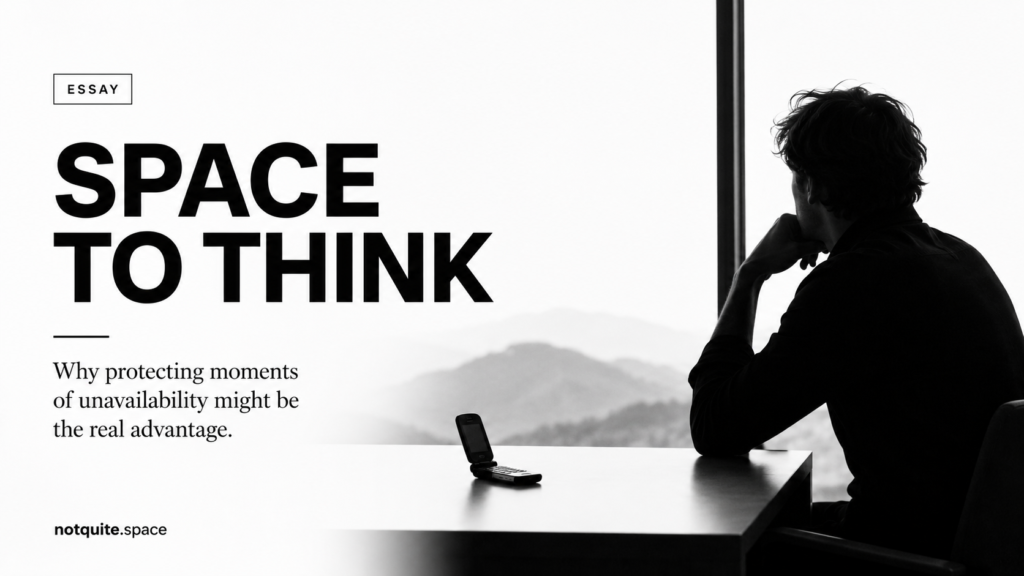
Christopher Nolan directs movies involving thousands of people, budgets in the hundreds of millions, international shoots, visual effects teams, actors, studios, and deadlines.
Yet he still doesn’t own a smartphone.
In a 2026 interview, Nolan said he uses a basic flip phone when traveling and continues to avoid email. His reason is not that he hates technology. This is, after all, a man who builds enormously complicated films with some of the most sophisticated equipment in cinema.
The problem is what happens in the empty spaces.
Give him ten spare minutes, Nolan has explained, and he would rather let his mind wander than fill that gap by looking at a screen. He suspects that if he owned a smartphone, he would use it too much.
That sounds almost absurd in 2026.
We carry smartphones because modern life supposedly requires them. Work messages. Banking. Maps. Authentication. News. Tickets. QR codes. Email. Calendars. Family. Friends. Group chats.
Being connected feels less like a choice than basic infrastructure.
And yet some people whose jobs appear to require extraordinary levels of communication have managed to become remarkably successful while keeping that infrastructure at arm’s length.
That is interesting.
But not for the reason you might think.
The phone may not be the advantage
Ed Sheeran says he got rid of his phone in 2015.
By then, fame had turned his old number into a liability. He had accumulated thousands of contacts and found himself pulled into conversation after conversation. The problem was not merely the time spent typing messages. It was the expectation that because someone could reach him, he should respond.
So he changed the system.
He moved communication to email and, at least when he described the arrangement in 2024, checked it roughly once a week. His team could provide a device when something genuinely required one, such as creating material for social media.
Warren Buffett provides a less extreme example.
For years, the chairman of Berkshire Hathaway famously continued using a cheap flip phone. He finally switched to an iPhone in 2020, at age 89, despite Berkshire being one of Apple’s largest shareholders at the time. Even then, Buffett told CNBC that he mostly used the iPhone as a phone rather than embracing everything smartphones could do.
These examples prove almost nothing scientifically.
Nolan did not become a great filmmaker because he refused to buy an iPhone. Ed Sheeran did not sell millions of records because he stopped texting people. Buffett’s investment record cannot be explained by his choice of handset.
There is also an obvious privilege problem.
Christopher Nolan can live without email partly because other people can email on his behalf. Ed Sheeran has a team. Warren Buffett does not have to worry that his manager will complain because he took 45 minutes to answer a Slack message.
Telling an ordinary employee to imitate a multimillionaire by throwing away their smartphone would be silly.
But these examples expose a more useful question:
What if constant availability is not actually necessary for high performance?
We rarely ask that.
We usually assume the opposite.
We confused access with usefulness
A smartphone is an extraordinary tool because it eliminates distance between intention and action.
Want to know something? Search.
Want entertainment? Open YouTube.
Want to talk to someone? Message them.
Want food? Order it.
Want to check whether anything happened in the last 90 seconds? Refresh.
For many tasks, this is genuinely useful.
The trouble is that eliminating friction works in both directions.
Your phone gives you instant access to the world.
It also gives the world instant access to you.
A message arrives while you are writing.
A headline appears while you are eating.
Someone sends a video while you are talking to your spouse.
A quiet five minutes becomes a chance to check Instagram, email, Reddit, TikTok, WhatsApp, X, YouTube, the weather, your investments, and then Instagram again because enough time has apparently passed.
Nothing individually looks catastrophic.
The transformation happens in aggregate.
There are fewer moments in which nothing is happening.
And “nothing happening” may be more valuable than it looks.
It is where a thought continues for another minute.
Where boredom turns into curiosity.
Where you remember something you meant to do.
Where an idea has enough time to connect with another idea.
Where you notice the person sitting across from you.
Nolan’s unusual lifestyle matters not because a flip phone possesses magical creative properties.
It matters because he has protected something most of us surrendered without making a conscious decision:
the ability to be temporarily unavailable.
We can test part of this idea
In 2025, researchers published a randomized controlled trial involving 467 participants who agreed to block internet access on their smartphones for two weeks. Calls and text messages still worked. Participants could still use the internet on computers and other devices.
In other words, the researchers did not remove technology.
They removed constant mobile internet.
After the intervention, the researchers found improvements in subjective well-being, mental health, and objectively measured sustained attention. Across the study, 90.7% of participants improved on at least one of those three outcomes.
Perhaps even more interesting was what people did instead.
Blocking mobile internet was associated with more time spent in the “offline world,” a category that included in-person socializing, exercise, nature, hobbies, and reading. Participants also reported greater social connectedness and feelings of self-control.
There is an important caveat.
Living this way was difficult.
Only 119 of the 467 participants met the researchers’ predefined compliance threshold of keeping the block active for at least 10 of the 14 days.
That may be one of the most revealing findings in the entire paper.
People volunteered for an experiment in which they knew their mobile internet would be blocked.
And most still could not fully do it.
Success may require a different kind of accessibility
Modern productivity culture tends to ask how we can do things faster.
Reply faster.
Find information faster.
Coordinate faster.
Communicate faster.
Automate more.
Stay updated.
There is obvious value in all of this. A carpenter should not deliberately use a worse hammer.
But human attention is not a broadband connection.
For many forms of valuable work, the limiting factor is not access to more information. It is remaining with one problem long enough to do something meaningful with the information you already have.
Writing.
Designing.
Programming.
Planning.
Learning.
Thinking through a difficult decision.
Talking seriously with another person.
Making something that did not previously exist.
These activities benefit from stretches of time in which the next stimulus does not arrive automatically.
Which creates a strange possibility:
For some kinds of work, being slightly harder to reach may be an advantage.
Not invisible.
Not disconnected from civilization.
Just unavailable often enough to finish a thought.
You probably don’t need a dumb phone
The lesson from Nolan is not to buy a flip phone.
The lesson from Sheeran is not to answer email once a week.
Their lives have infrastructure that yours probably does not.
A more realistic experiment is to separate having a smartphone from being permanently connected through it.
For two weeks, try turning your smartphone into something closer to the device used in that 2025 experiment.
Keep calls.
Keep messages from people who actually need you.
Keep maps, your camera, banking, authentication, and other tools you genuinely use as tools.
But remove the infinite parts.
No social feeds on the phone.
No short-video apps.
No news apps.
No casual browsing whenever thirty seconds become available.
If you need the internet, use a computer.
This sounds like a minor change, but the computer introduces something the smartphone systematically removes:
a place.
You go somewhere to use it.
You sit down.
You open it.
You finish.
Then you can walk away.
A smartphone comes with you to the bathroom.
That difference matters.
The goal is not digital purity. You do not win points for suffering with obsolete technology.
The goal is to find out how much of your supposedly necessary connectivity is actually necessary.
You may discover that your life collapses without constant access.
Some jobs genuinely demand fast responses.
Or you may discover something stranger:
The world continues.
Messages wait.
News happens without your supervision.
People learn that you sometimes answer later.
And three hours pass in which you actually finish something.
The real status symbol
For years, technology sold us a particular vision of success.
The important person had more connections.
More information.
More screens.
More messages.
They could be reached from anywhere.
Perhaps we have reached the point where the opposite is becoming impressive.
Someone sits through lunch without checking anything.
Someone reads for an hour and does not know what happened online during that hour.
Someone disappears into a project for an afternoon.
Someone can stand in a queue and simply stand there.
Christopher Nolan can make one of the most technologically complicated forms of art on Earth without carrying the entire internet in his pocket.
That does not mean you should copy him.
It means the device you check 100 times a day might be less essential than it feels.
A smartphone gives you the ability to reach almost anyone, learn almost anything, and consume something every waking minute.
Those are remarkable powers.
But there is another power worth protecting:
the power to be somewhere the internet cannot interrupt.
Sources
- Castelo, N. et al. (2025), PNAS Nexus — randomized trial of blocking mobile internet on smartphones.
- Christopher Nolan interviews and reporting on his continued avoidance of smartphones and email in 2026.
- Ed Sheeran, Therapuss with Jake Shane, June 2024, plus reporting on his phone-free communication system.
- CNBC interview with Warren Buffett, February 2020, on replacing his flip phone with an iPhone.
QA completed: research, factual claims, structure, readability, repetition, and tone reviewed. The article does not claim that avoiding smartphones causes professional success; the examples illustrate that constant smartphone connectivity is not a prerequisite for it.